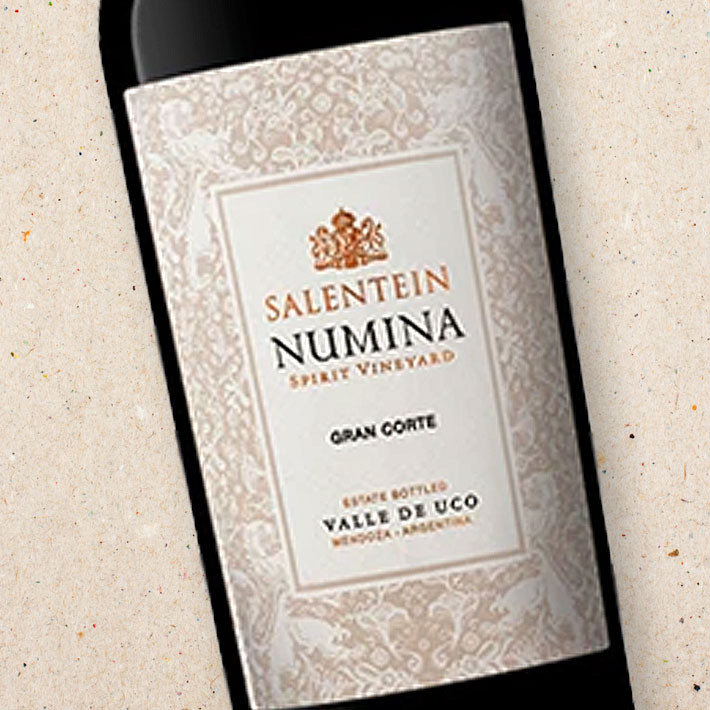

Salentein Numina Gran Corte 2022

Expressive and intensely aromatic with pronounced notes of black pepper, tomato leaf and tobacco leaf along with dark berried fruit. Juicy and fresh with well-integrated tannins and a long, elegant finish.
60% of the Malbec component originated from Finca La Pampa, with the remaining 40% sourced from Finca El Oasis. The Cabernet Sauvignon vines are clones 169 and 337 and, along with the Petit Verdot, were grown at the Finca El Oasis vineyard. The Cabernet Franc comes from clones 331, 210, and 214 and was sourced from Finca El Oasis, while the Merlot component came from Finca La Pampa. The Finca El Oasis vineyard covers 465 hectares and was planted from 1996 to 2012. It is situated in Los Árboles at 1,050 to 1,175 metres above sea level. Finca La Pampa covers 260 hectares and was also planted between 1996 and 2012. This vineyard lies within the San Pablo GI at an elevation of 1,175 to 1,300 metres. Both estates employ drip irrigation and preserve native flora between the vine rows. The vines are trellis-trained, and the alluvial soils are loamy sand with loess deposits and calcium carbonate-encrusted stones.
All grapes were hand-picked, and each variety was fermented separately. The Malbec fermented in stainless steel tanks, with a portion also undergoing fermentation in 7,000-litre foudres. Portions of the Cabernet Franc and Cabernet Sauvignon were micro-vinified in barrels, with the remainder fermented in foudres and stainless-steel tanks. The Merlot and Petit Verdot fermented in stainless steel tanks. All varieties underwent cold maceration at 8 to 10°C for 3 to 4 days. Fermentation took place at 28-29°C for 7-13 days, with an additional 5-10 days of maceration. The wines were racked and transferred to oak barrels for spontaneous malolactic conversion. After six months' maturation, the wines were blended and returned to barrels for a further 10 months.
| Vintage | 2022 |
| Alcoholic strength | 14.5% |
| Awards | 93 Pts, Tim Atkin MW, 2025; 91 Pts, Wine Enthusiast, 2025 |
| Country | Argentina |
| Region | Valle de Uco |
| Subregion | Tunuyán |
| Grapes | Malbec 52%, Cabernet Sauvignon 20%, Cabernet Franc 12%, Merlot 9%, Petit Verdot 7% |
| Residual sugar (g/l) | 2 |
| Body | D |
| Contains sulphites | Yes |
| Vegetarian | Yes |
| Vegan | Yes |
| Milk | No |
| Eggs | No |
| Organic | No |
| Biodynamic | No |
| Closure | Diam |
Bodegas Salentein is nestled in the picturesque Uco Valley just south of Mendoza. In 1996, Dutch entrepreneur Mijndert Pon purchased the estate in what initially seemed to be a rocky desert. He ambitiously embarked on planting vineyards at high altitudes with the aim of producing ‘wines like no other.’ A year later, construction of the magnificent cross-shaped winery began. The four wings of the landmark winery each ferment the wines before gravity transfers it to the underground cellars. The high-altitude vines are planted at an elevation of between 1,050 and 1,600 metres, against the breathtaking backdrop of the Andes Mountains. At this altitude, the vines benefit from optimal diurnal temperature differences and a diverse terroir in which they flourish. Today, Bodegas Salentein is one of the most admired Argentine wineries - not just in the Uco Valley, but in the world. Their focus is producing terroir-driven wines which express the essence of the Uco Valley, and they do so with great purity and finesse.
30 other products in the same category: