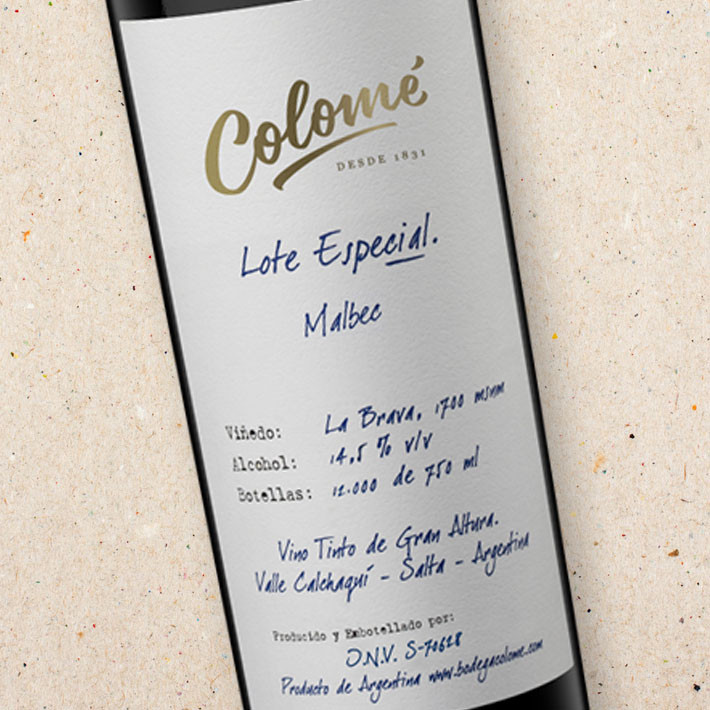

Bodega Colomé Lote Especial La Brava Malbec 2023


Deep purple in colour. Aromas of ripe red fruits with underlying floral and spice notes. On the palate, this wine is powerful yet refined, with round tannins, great freshness and an intense, lingering finish.
The 11 hectare La Brava vineyard in is located at 1,700 metres above sea level and is planted with Malbec, Cabernet Sauvignon, Tannat, Bonarda and Torrontés. The Malbec vines are over 20 years old. Soils are sandy and rocky, producing wines with delicate red fruits and soft tannins.
Fruit was hand harvested before going through an optical selection process and a four day period of cold maceration. Fermentation took place in stainless-steel tanks with indigenous yeasts at 24 degrees, with twice daily, gentle pump-overs. There was then an extended period of maceration of 30 days before ageing in 225-litre French oak barrels, of which 25% were new, for 12 months.
| RRP | £24.99 |
| Bottle size | 75cl |
| Vintage | 2023 |
| Alcoholic strength | 14.5% |
| Country | Argentina |
| Region | Salta |
| Grapes | Malbec 100% |
| Residual sugar (g/l) | 1.8 |
| Vegetarian | Yes |
| Vegan | Yes |
| Organic | No |
| Biodynamic | No |
| Closure | Diam |
Established in 1831, Bodega Colomé is the oldest working winery in Argentina and home to one of the world's highest commercial vineyards, ‘Altura Máxima’, planted at a staggering 3,111 metres above sea level. The combination of Bodega Colomé’s history, vineyard sites and winemaking talent means they have been consistently classified as a 'First Growth' winery by Tim Atkin MW, in his Annual Argentina Report, since 2020.
Bodega Colomé is based in the northern Argentinian wine region of Upper Calchaquí Valley. The estate is thought to have been founded by the Spanish Governor of Salta, Nicolás Severo de Isasmendi y Echalar, whose daughter brought the first pre-phylloxera Malbec and Cabernet Sauvignon vines to Bodega Colomé in 1854. These vineyards are still farmed by the Bodega today, which has since grown to become one of Argentina’s most respected wineries.
Bodega Colomé’s modern reputation began to take shape in 2001 when they were purchased by Swiss entrepreneur Donald Hess (of Hess Collection, Napa Valley fame). Hess not only invested in the vineyards and winery but also into the Colomé village, converting it from a forgotten backwater into a thriving community with multiple schools, a community centre and even an art museum. Many of the now 400-strong villagers are also employed at Bodega Colomé, evidencing the winery's commitment to social sustainability and maintaining the local economy they helped build.
This approach to sustainability also translates to the environment, with Bodega Colomé having 140 hectares of vineyards planted at elevations between 1,700 and 3,111 metres above sea level. These include the three key estate vineyards: ‘La Brava’ (1,750 metres) in Cafayate, ‘Finca Colomé’ (2,300 metres) which surrounds the winery in Molinos and ‘Altura Máxima’ (3,111 metres), in the Payogasta area. Grapes grown at such high elevations, with minimal crop coverage, develop naturally thick skins as protection from the sun’s intense ultraviolet rays. These significant elevations also create a diurnal range of more than 20°C between day and night. This is crucial for achieving quality and balance, with the warmer daylight hours ensuring successful ripening and the dramatically cooler nights preserving acidity and fragrance.
Combining these factors further contributes to lengthening the growing season, resulting in wines with supple, complex tannins, rich colour and a deep, nuanced flavour profile. French winemaker Thibaut Delmotte has been the custodian of Bodega Colomé since 2005, taking the Bodega from being a very good producer to the outstanding Argentinian ‘First Growth’ we know today, through his meticulous, low-intervention philosophy.
30 other products in the same category: